I'm generally a big fan of short stories. I love how a skillful short story writer can pack a whole lot into a small space. Strout has taken that format and made it much tougher for herself by linking the short stories in "Anything Is Possible."
Everyone in these stories is somehow related to the main character in her previous novel, "My Name Is Lucy Barton," which is a clever choice. I read an interview with Strout in which she said she wrote both books at the same time, moving back and forth between them as a scene occurred to her. I'd think that was a tough way to write a novel, but whatever works!
Her writing it spare, which fits with the bleakness of her characters' lives. This is my third Strout novel, and I've yet to read about anyone chipper and carefree. These are some tormented people! Every type of malady and misfortune has beset these folks, and most of them don't deal with their troubles very well. Nearly everyone should be in intensive therapy, but some of the characters are too far gone to have even great therapy help much.
I know this sounds like a book no one would want to read, but she's a great storyteller, able to weave in little pieces of the characters' personalities to make each of them whole. They're not very likable, they wouldn't be fun at a party, and your life would not be enriched by knowing most of them. But she does such a great job of creating them and making their horrible lives interesting that you can't put the book down. If you want to read a book where you can say, "Boy, my life is sooooo much better than all of those people," this is the one for you.
Tuesday, March 5, 2019
Outline by Rachel Cusk
It's not often you read a book written in a style you're unfamiliar with, but "Outline" was a new experience for me. It's not really a novel, and it's not really short stories. I suppose you could call the chapters "conversations," since each focuses on an interaction between the narrator and another person, or group of people. But that's not really accurate, since the conversations aren't traditional conversations. They're more like summaries, with the narrator sometimes slipping between tenses.
Cusk breaks a lot of rules, but she's breaking them intentionally and carefully. Her powers of description are excellent, and the conversations are mostly interesting. But it's not the kind of book that draws you in emotionally. Part of that is the style, since she's created an emotional distance between you and the characters. But part of it is because no one's really that appealing. Every character has something or many things that make them hard to like. Clearly, she's doing this on purpose, and that allows her to create very realistic characters. But when you dig beneath the veneer of most real people, you find things you wish you didn't know, and that's exactly what happens in "Outline." The characters seem like real people you wish you didn't have to interact with.
So if you'd like to read very thoughtful, deep conversations between vaguely unlikeable people, with beautiful descriptions of where they are, you're in luck!
Cusk breaks a lot of rules, but she's breaking them intentionally and carefully. Her powers of description are excellent, and the conversations are mostly interesting. But it's not the kind of book that draws you in emotionally. Part of that is the style, since she's created an emotional distance between you and the characters. But part of it is because no one's really that appealing. Every character has something or many things that make them hard to like. Clearly, she's doing this on purpose, and that allows her to create very realistic characters. But when you dig beneath the veneer of most real people, you find things you wish you didn't know, and that's exactly what happens in "Outline." The characters seem like real people you wish you didn't have to interact with
So if you'd like to read very thoughtful, deep conversations between vaguely unlikeable people, with beautiful descriptions of where they are, you're in luck!

Saturday, March 2, 2019
Alternate Side by Anna Quindlen
I loved reading Anna when she had a regular column in the NY Times, and I still think she's a very good observer of this place, in this time.
Alternate Side was easily as good as her other work, and reading it was a pleasurable experience. But... This year, I decided that I was generally only going to read books by women, then I changed my rule to include men of color. That's going pretty well, but I'm coming to realize that I've read the story of a middle-aged, upper-class New Yorker more times than I can count. The books are good, but they're not telling me much I don't already know. So I'm going to narrow my list down a little more. My new goal is to find writers whose lives are different than mine in some significant way. Even though I have a decent amount of time to read, I don't have enough to tread the same ground over and over again.
So I give two thumbs up for Alternate Side if you aren't overly familiar with the indignities of owning a full-floor brownstone on the Upper West Side, while aging slightly, but not enough that rich and powerful men still chase you. I know that sounds snarky, but I don't intend for it to be. I think books like this are very popular with straight women who can empathize with the narrator's small trials and tribulations. I suppose they're like romance novels for lesbians, but with less sex and more ennui.
I'm not going to post an Amazon review for this because I'm not enthusiastic enough about it to praise it. I'm not averse to slamming a book that's sloppily edited or carelessly researched, but I never do that to a good book that wasn't quite for me.
Alternate Side was easily as good as her other work, and reading it was a pleasurable experience. But... This year, I decided that I was generally only going to read books by women, then I changed my rule to include men of color. That's going pretty well, but I'm coming to realize that I've read the story of a middle-aged, upper-class New Yorker more times than I can count. The books are good, but they're not telling me much I don't already know. So I'm going to narrow my list down a little more. My new goal is to find writers whose lives are different than mine in some significant way. Even though I have a decent amount of time to read, I don't have enough to tread the same ground over and over again.
So I give two thumbs up for Alternate Side if you aren't overly familiar with the indignities of owning a full-floor brownstone on the Upper West Side, while aging slightly, but not enough that rich and powerful men still chase you. I know that sounds snarky, but I don't intend for it to be. I think books like this are very popular with straight women who can empathize with the narrator's small trials and tribulations. I suppose they're like romance novels for lesbians, but with less sex and more ennui.
I'm not going to post an Amazon review for this because I'm not enthusiastic enough about it to praise it. I'm not averse to slamming a book that's sloppily edited or carelessly researched, but I never do that to a good book that wasn't quite for me.
Thursday, March 2, 2017
I got woke a little bit more at "Get Out."
Yesterday, I paid cash money to watch a horror film. This was the first time in my life that I’ve done that, and I surprised myself when I handed over the dough. But I really like Jordan Peele, and I’d heard good things about “Get Out” from people whose opinions I respect, so I took the leap.
Let me preface by saying I not only don’t like horror, I don’t much care for violence in movies, especially gratuitous violence. And even though I’m not a student of the genre, gratuitous violence kinda seems like the point to a horror film.
A crisp 103 minutes later, I was very pleased I’d gone to see it—particularly in the theater, rather than at home. Partly, that was because the audience, familiar with the tropes, warned me to shut my eyes right before something bad happened. Thanks, people at the 3:15 showing at the 34th St. Loews!
But watching a movie that’s actually a very clear-eyed take on race with a largely black audience reminded me again of how I can never view the world in the same way a black person can.
It’s not that I wouldn’t like to, of course. I just can’t. That was brought home to me again during a critical point in the movie when the protagonist(s) (no spoilers!) were in the soup and a police car rolled up.
Yeah! The cavalry had arrived! But the audience let out a collective, weary sigh, clearly signaling they agreed “they’re screwed now.” That hit me like a slap.
Of course I’m very aware of the way people of color are often singled out for increased scrutiny/harassment/violence from security personnel of all types. But being aware isn’t the same as having the experience. I will always be a person who’s treated with a certain amount of deference by security guards and peace officers. And many, if not most, black and brown people will not be.
Given the issue didn’t get better in any measurable way during eight years of a president and two attorneys general who I believe truly wanted to change this fact, I’m very disheartened. But that doesn’t give me permission to just throw up my hands and write this off as a lost cause.
Those of us with privilege have to use it to try to hold our leaders responsible for this state of affairs. Obviously, this would be easier to do if all of the people who were targets of unfair treatment voted. We’re going to be a minority majority country soon, and if every member of a minority group fought for their rights, they’d be able to make some significant changes.
But it’s hard to convince people to take part in a game they’re convinced is rigged. Again, that doesn’t mean we get a pass to ignore the issue.
I’ve been cheered by President Obama and former A.G. Eric Holder working together to make some progress on doing away with gerrymandering, which keeps minority populations from being able to win more legislative seats. But that’s just a very preliminary step on the long road we have to cover.
We have so many critical issues to care about right now, with our current government seemingly intent on taking away every bit of progress we’ve made over the last few decades. But we’ve got to keep this issue at the top of the list. Over a hundred and fifty years after the purported end of slavery, it’s long past time to treat all of our citizens with the same level of dignity and respect.
As a GIF I saw yesterday reminded me, "Equal rights are not like pie. There's plenty for everyone."
Susan
P.S. One last thing—until 3-9-17, PBS is providing free access to a very compelling Independent Lens documentary on The Birth Of A Nation, called Birth Of A Movement. It’s only an hour long, and well worth your time. Unless you’re a very keen student of the history of the early 20th century, you’ll learn something. And even if you are, it was nice to have a little additional light put onto this dark piece of film history.
Sunday, January 22, 2017
Women's March
Since November the eighth, I've woken with anywhere from a moderate to a severe sense of dread. Many days I labor under a pervasive sense of doom that I've been unable to shake.
I still work, but my work has been pretty lackluster. I still see friends, but nearly all of them are as upset as I am, so we try to ignore our collective ennui and have fun. But that dark shadow doesn't truly go away. It lurks around the edges, taking the shine off otherwise enriching encounters.
I long to talk about how I feel, but it has become a tail-chasing experience. No matter how many times you run around that circle, you never quite catch it.
When I first heard about the Women's March, I was pleased to learn that at least one group of people were getting off their sofas to do something positive. But I never seriously thought of going to Washington, even though it's a pretty easy trip for me. My main worry was that DC would be filled with supporters of the incoming president, and there would be far too many opportunities for me to flap my trap at provocateurs. I have bat ears, and every snide remark can goad me into responding. This isn't good for my mental health, so I try to avoid situations that might be too loaded.
I was very pleased when I heard the march was going to have local branches. Since fewer than 6% of Manhattan voted for the current president, I knew I'd be with my peeps. Perhaps that's not the ideal way to be. It would probably be better to go to Wyoming, where over 70% of the population voted for the current president. Showing up for the 2,000 women marching in Cheyenne might have been helpful, or had a bigger impact. But we can only do what we feel capable of. Self-care shouldn't be something to be ashamed of.
Armed with the knowledge that I'd be among friends, I took off from the wilds of New Jersey for the long ride into the city. Immediately, I was cheered to see that at least twenty percent of the passengers were going to the march, with pink pussy hats, pink scarves, buttons, and signs. Like breast cancer awareness month, but with an angry edge.
As we left Penn Station, a woman rode by on a bicycle, with a sign strapped to her basket, homemade pink hat in lieu of a helmet. My mood continued to brighten. As we walked, we encountered more and more women clearly headed our way. Then we noticed a lot of men in the group. That surprised me, but I was pleased. If you love women, marching for their freedom makes perfect sense.
Nearing Fifth Avenue, I heard one of those ear-splitting police cruiser horns, the kind that rattle your bones. But it wasn't a horn. It was a roar of people, their collective voices echoing off the buildings, a canyon full of outrage.


We slid into the group, immediately surrounded by surprisingly buoyant people. The roar we'd heard was almost like a wave, starting here or there and building strength as it traveled. But there were no words spoken. It wasn't a chant. I'd describe it more as a howl. Then it passed, with everyone smiling.


That's when it really hit me. We'd all been in roughly the same mental space for the past two months. This was our first time to join a group, throw our heads back, and let out a primal scream. It was incredibly heartening! You could feel peoples' moods lighten. Not because we thought anything would change in that moment. More that we we cheered to see how many of us were willing to stand up and be counted. When the president cares only about optics, it's vital to show there's a sizable group of people who disagree with his agenda, and the plans of his cabinet appointees. That's why my favorite chant of the day was "This is what democracy looks like. This is what America looks like."


This is what America looks like: all ages, all races, all sexual orientations, all gender identities, all the points on the socio-economic strata.
This is what democracy looks like, and the march reminded me that the work of keeping democracy alive isn't done by sitting on the sidelines while a bunch of billionaires dismantles it.
I believe we've gotten lazy. Democrats have let themselves fall into the trap of believing in demographics. We see the country is slowly becoming more diverse, and we've assumed those black and brown people will logically vote Democratic. But that's a lazy way to look at it. We need to do what the Tea Party has been spectacularly successful at--starting small and working their way up.
That's why I recommend getting involved on your local level. There's a group called Indivisible, formed by former Congressional staffers, that's working to do just that.
They have branches throughout the country, focused on clawing back our state legislatures. That's what we have to focus on. We have to do something. Things won't change tomorrow. We're going to lose a LOT of rights we thought we'd locked up. So we have to be ready to yank them back. Given I'm not an anarchist, I believe the way to do that is to organize and vote.
We screwed up in November. Now we have to use that defeat as a motivator to swear to ourselves we won't let that happen again. We might lose a skirmish, but we can't afford to lose the war. Our lives depend upon it.
I'm facing this day with a new attitude. It's not over. In fact, the fight has just begun.
I still work, but my work has been pretty lackluster. I still see friends, but nearly all of them are as upset as I am, so we try to ignore our collective ennui and have fun. But that dark shadow doesn't truly go away. It lurks around the edges, taking the shine off otherwise enriching encounters.
I long to talk about how I feel, but it has become a tail-chasing experience. No matter how many times you run around that circle, you never quite catch it.
When I first heard about the Women's March, I was pleased to learn that at least one group of people were getting off their sofas to do something positive. But I never seriously thought of going to Washington, even though it's a pretty easy trip for me. My main worry was that DC would be filled with supporters of the incoming president, and there would be far too many opportunities for me to flap my trap at provocateurs. I have bat ears, and every snide remark can goad me into responding. This isn't good for my mental health, so I try to avoid situations that might be too loaded.
I was very pleased when I heard the march was going to have local branches. Since fewer than 6% of Manhattan voted for the current president, I knew I'd be with my peeps. Perhaps that's not the ideal way to be. It would probably be better to go to Wyoming, where over 70% of the population voted for the current president. Showing up for the 2,000 women marching in Cheyenne might have been helpful, or had a bigger impact. But we can only do what we feel capable of. Self-care shouldn't be something to be ashamed of.
Armed with the knowledge that I'd be among friends, I took off from the wilds of New Jersey for the long ride into the city. Immediately, I was cheered to see that at least twenty percent of the passengers were going to the march, with pink pussy hats, pink scarves, buttons, and signs. Like breast cancer awareness month, but with an angry edge.
As we left Penn Station, a woman rode by on a bicycle, with a sign strapped to her basket, homemade pink hat in lieu of a helmet. My mood continued to brighten. As we walked, we encountered more and more women clearly headed our way. Then we noticed a lot of men in the group. That surprised me, but I was pleased. If you love women, marching for their freedom makes perfect sense.
Nearing Fifth Avenue, I heard one of those ear-splitting police cruiser horns, the kind that rattle your bones. But it wasn't a horn. It was a roar of people, their collective voices echoing off the buildings, a canyon full of outrage.

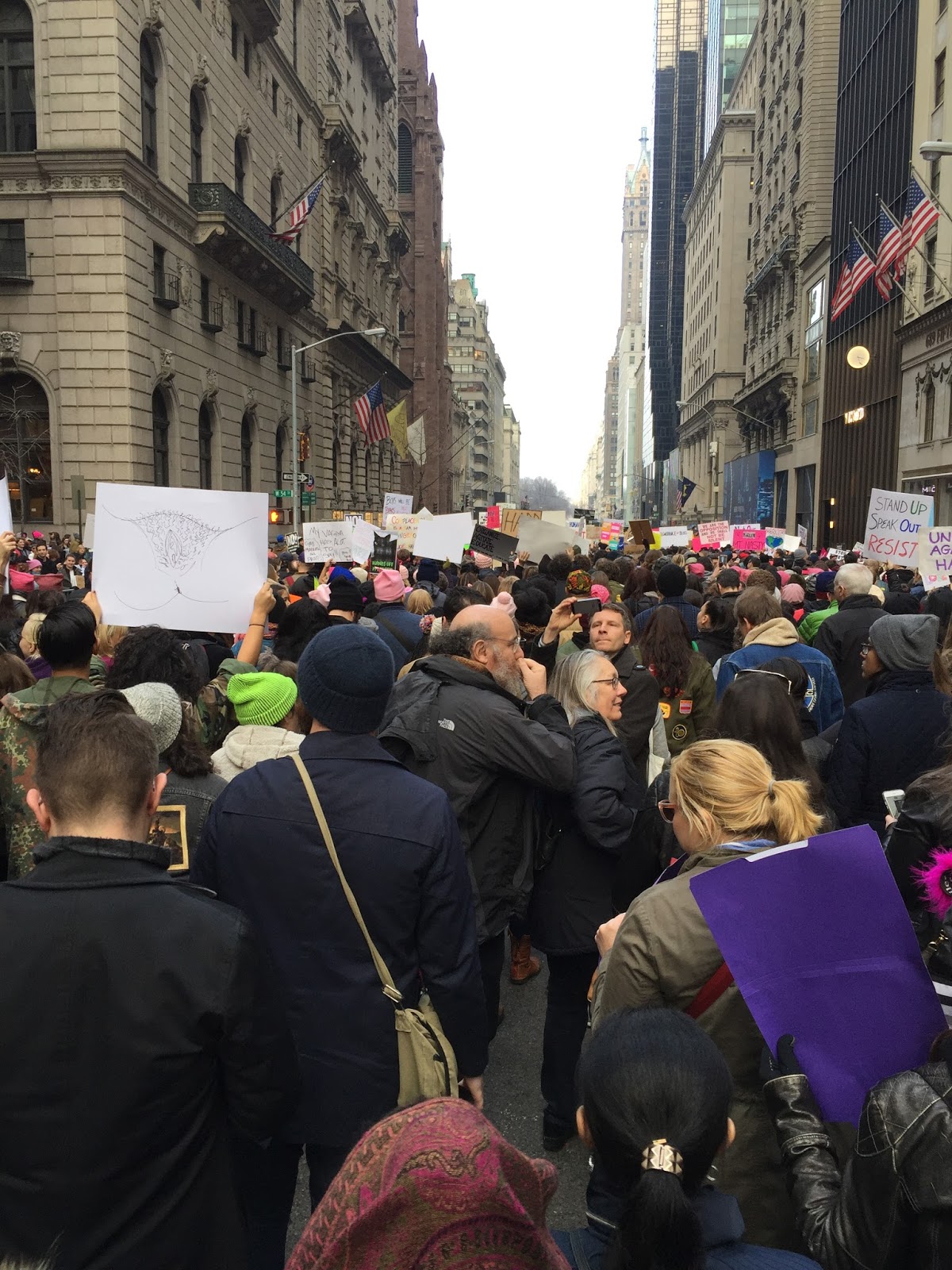
We slid into the group, immediately surrounded by surprisingly buoyant people. The roar we'd heard was almost like a wave, starting here or there and building strength as it traveled. But there were no words spoken. It wasn't a chant. I'd describe it more as a howl. Then it passed, with everyone smiling.


That's when it really hit me. We'd all been in roughly the same mental space for the past two months. This was our first time to join a group, throw our heads back, and let out a primal scream. It was incredibly heartening! You could feel peoples' moods lighten. Not because we thought anything would change in that moment. More that we we cheered to see how many of us were willing to stand up and be counted. When the president cares only about optics, it's vital to show there's a sizable group of people who disagree with his agenda, and the plans of his cabinet appointees. That's why my favorite chant of the day was "This is what democracy looks like. This is what America looks like."


This is what America looks like: all ages, all races, all sexual orientations, all gender identities, all the points on the socio-economic strata.
This is what democracy looks like, and the march reminded me that the work of keeping democracy alive isn't done by sitting on the sidelines while a bunch of billionaires dismantles it.
I believe we've gotten lazy. Democrats have let themselves fall into the trap of believing in demographics. We see the country is slowly becoming more diverse, and we've assumed those black and brown people will logically vote Democratic. But that's a lazy way to look at it. We need to do what the Tea Party has been spectacularly successful at--starting small and working their way up.
That's why I recommend getting involved on your local level. There's a group called Indivisible, formed by former Congressional staffers, that's working to do just that.
https://www.indivisibleguide.com
They have branches throughout the country, focused on clawing back our state legislatures. That's what we have to focus on. We have to do something. Things won't change tomorrow. We're going to lose a LOT of rights we thought we'd locked up. So we have to be ready to yank them back. Given I'm not an anarchist, I believe the way to do that is to organize and vote.
We screwed up in November. Now we have to use that defeat as a motivator to swear to ourselves we won't let that happen again. We might lose a skirmish, but we can't afford to lose the war. Our lives depend upon it.
I'm facing this day with a new attitude. It's not over. In fact, the fight has just begun.
Friday, November 11, 2016
Further reflections on election day and beyond
I’ve had some time to digest the events of this week, and I’m feeling better. Not good, of course, but better. Here’s why:
I’ve decided to limit my consumption of “news” and “analysis.” No organization is very good at either, and I don’t need more stimulation of my reptilian brain. I do very well at making myself a nervous wreck. The last thing I need is help.
I’ve going to divert my attention to things that make me feel better. I fully realize that The Affordable Healthcare Act is doomed. That Planned Parenthood will lose its federal funding. That services for the poor and the marginalized will be cut. That tax breaks for those who don’t need them will skyrocket, and that those who can least afford to pay more will be forced to. But…I can’t make those certainties not happen. Watching carefully as everything I care about is gleefully dismantled is something I have no stomach for.
Instead, I’m going to take the money I gain from having my taxes lowered and give it to organizations that I support. Organizations that are true to the values I hold dear. I’ve just got to find a way to give without having them know who I am, as they’ll start covering me with emails telling me the sky is falling. It’s already fallen.
Longer term, I’m going to try to find and support organizations that work to reach people who feel their votes don’t matter/don’t count. People like Colin Kaepernick. People who are profoundly unhappy with America, yet won’t take a half hour to cast a ballot. I don’t believe these folks are lazy. I believe they’ve lost all hope of change and firmly believe the system I believe in is a Potemkin Village. We’ve got to find a way to reach these people if we ever want a Democratic majority again.
I’m going to continue to limit my consumption of social media. I need to work on being optimistic, and reading how unhappy everyone is isn’t in my best interests.
Lastly, I’m going to acknowledge that someone I intensely dislike is my president. I believe in democracy—even when my side doesn’t win.
This Veterans Day, we should not only acknowledge the sacrifices so many men and women have made to keep this country safe and whole. We should remember that as a nation we’ve survived some very dark times. It’s going to be a very tough few years, but I believe we’ll make it if we as individuals support and care for each other—even if the government tries to cull those who most need its help.
Wednesday, November 9, 2016
Post Mortem
I hope this is just a post-mortem on the election and not our system of government. I'll try to be optimistic, and say it's the former.
I don't think I have anything to say that others have not said better and more clearly. But I feel better when I force my thoughts to coalesce and put them on virtual paper. So stick with me if you're so inclined.
I'm surprisingly not angry at the orange-tinted pile of oily rags we just elected our forty-fifth president. I can't stand the sight of him, and hope to never have to listen to his voice, but I can't say he tricked his way into the job. He said exactly what his unfiltered ego told him to say and it worked! He was the right person for a portion of the electorate at exactly the right time. Add to that his ability to excite the reptilian brains of his followers, then stroke their fear and loathing, and you've got a perfect storm.
In my mind, his voters come in three main buckets:
One is the large number of white men who used to run the place, or at least be guaranteed a decent, stable job. Obviously, it's upsetting to have once had control of the sandbox then have other kids come in and want to share. The problem is that it wasn't your sandbox. You'd just figured out ways to control it exclusively.
Over time, your control lessened and you're pissed. Really pissed. You want to go back to the time when every able bodied white man could slack off and quit high school yet still get a good job in a factory, have your wife stay home with the kids, and be fairly sure your kids would have more opportunities than you did. Your wife had your dinner on the table at six, you lived in an all white neighborhood, and everyone spoke English. Bliss!
I don't have a lot of sympathy for these people. They've run the place for over two hundred years and it's time to start sharing. But I have some sympathy for them, only because I know what it's like to have people wrest control from your hands.
The second bucket is the bad guys. Really bad guys. The racists, misogynists, Islamaphobes, anti-immigrants, nativists, fascists, white supremacists, and other creeps who lurk at the bottom of the internet. There aren't tens of millions of them, but it seems like there are. They are now emboldened by the new president of the United States to hold their hate-filled views and express them with pride.
I have nothing but antipathy for these people. They don't deserve to have an audience. With time, they might slither back into their lairs, but that's not going to happen without decent people rejecting their message.
The third bucket is the group I'm most angry with. Those are the well-educated, fairly open-minded, socially liberal people who vote republican just so they pay less in taxes, and hope for less government regulation. These are people who have friends of different races, a gay brother-in-law, a niece who's married to a Muslim, all of whom they get along with just fine. But they don't truly care about anyone or anything but their own finances. They're beyond my contempt because they're smart enough to know better. They think some adults will come in and control the new president. That congress and the courts will stop him from doing anything too crazy. Good luck with that. Thanks for putting democracy at risk on the off-chance that someone can stop us from going over a cliff.
So that's why I think this happened. Those three groups got together--even though their goals are very divergent. The candidate convinced them he heard and understood them. He didn't and he doesn't, but they wanted to believe, so they jumped on board.
Against this, Hillary had to overcome systemic misogyny, thirty years of biased news reporting against her, and her own inability to promise people in Trump's three groups anything they wanted.
I can understand why she had a tough time doing that. To appeal to them would have eroded her own base. But her base screwed her in the end. Women let her down. Black people let her down. Latin people let her down. Young people let her down. Well, technically, they let themselves down. But each of those voting blocks gave her less support than they gave to Obama. My guess is that many of them just didn't bother to vote. She didn't excite them. She didn't speak to them in a way they could relate to. So they convinced themselves that it didn't really matter. That there wasn't much difference between an old, rich, white woman and an old, rich, white man. I fear they are tragically wrong.
My only thread of hope is that the natural allies of a liberal, social-consious democracy will see that it does matter who holds the oval office and that they never take it for granted again. That's not much to go on, given that the republicans now hold most statehouses, the Congress, the White House and the Supreme Court, but it's all I've got.
Even though we're outnumbered, those numbers can change. We have to do a better job in 2018. We simply have to.
I don't think I have anything to say that others have not said better and more clearly. But I feel better when I force my thoughts to coalesce and put them on virtual paper. So stick with me if you're so inclined.
I'm surprisingly not angry at the orange-tinted pile of oily rags we just elected our forty-fifth president. I can't stand the sight of him, and hope to never have to listen to his voice, but I can't say he tricked his way into the job. He said exactly what his unfiltered ego told him to say and it worked! He was the right person for a portion of the electorate at exactly the right time. Add to that his ability to excite the reptilian brains of his followers, then stroke their fear and loathing, and you've got a perfect storm.
In my mind, his voters come in three main buckets:
One is the large number of white men who used to run the place, or at least be guaranteed a decent, stable job. Obviously, it's upsetting to have once had control of the sandbox then have other kids come in and want to share. The problem is that it wasn't your sandbox. You'd just figured out ways to control it exclusively.
Over time, your control lessened and you're pissed. Really pissed. You want to go back to the time when every able bodied white man could slack off and quit high school yet still get a good job in a factory, have your wife stay home with the kids, and be fairly sure your kids would have more opportunities than you did. Your wife had your dinner on the table at six, you lived in an all white neighborhood, and everyone spoke English. Bliss!
I don't have a lot of sympathy for these people. They've run the place for over two hundred years and it's time to start sharing. But I have some sympathy for them, only because I know what it's like to have people wrest control from your hands.
The second bucket is the bad guys. Really bad guys. The racists, misogynists, Islamaphobes, anti-immigrants, nativists, fascists, white supremacists, and other creeps who lurk at the bottom of the internet. There aren't tens of millions of them, but it seems like there are. They are now emboldened by the new president of the United States to hold their hate-filled views and express them with pride.
I have nothing but antipathy for these people. They don't deserve to have an audience. With time, they might slither back into their lairs, but that's not going to happen without decent people rejecting their message.
The third bucket is the group I'm most angry with. Those are the well-educated, fairly open-minded, socially liberal people who vote republican just so they pay less in taxes, and hope for less government regulation. These are people who have friends of different races, a gay brother-in-law, a niece who's married to a Muslim, all of whom they get along with just fine. But they don't truly care about anyone or anything but their own finances. They're beyond my contempt because they're smart enough to know better. They think some adults will come in and control the new president. That congress and the courts will stop him from doing anything too crazy. Good luck with that. Thanks for putting democracy at risk on the off-chance that someone can stop us from going over a cliff.
So that's why I think this happened. Those three groups got together--even though their goals are very divergent. The candidate convinced them he heard and understood them. He didn't and he doesn't, but they wanted to believe, so they jumped on board.
Against this, Hillary had to overcome systemic misogyny, thirty years of biased news reporting against her, and her own inability to promise people in Trump's three groups anything they wanted.
I can understand why she had a tough time doing that. To appeal to them would have eroded her own base. But her base screwed her in the end. Women let her down. Black people let her down. Latin people let her down. Young people let her down. Well, technically, they let themselves down. But each of those voting blocks gave her less support than they gave to Obama. My guess is that many of them just didn't bother to vote. She didn't excite them. She didn't speak to them in a way they could relate to. So they convinced themselves that it didn't really matter. That there wasn't much difference between an old, rich, white woman and an old, rich, white man. I fear they are tragically wrong.
My only thread of hope is that the natural allies of a liberal, social-consious democracy will see that it does matter who holds the oval office and that they never take it for granted again. That's not much to go on, given that the republicans now hold most statehouses, the Congress, the White House and the Supreme Court, but it's all I've got.
Even though we're outnumbered, those numbers can change. We have to do a better job in 2018. We simply have to.
Wednesday, August 24, 2016
Italian Earthquake
Like many of you, my heart goes out to the people affected by the devastating earthquake that hit central Italy this morning. The damage spans several regions, with Umbria and Lazio looking like they've sustained the most deaths.
I'm no expert on Italy, but I've visited several times, including one extended vacation to a hill town in Umbria close to Perugia, the epicenter of today's quake. We stayed in an apartment that was built in the 1500s, with several big holes cut into the remarkably thick walls that allowed for plumbing and electricity to be added centuries later. That little town, Todi, was very much like the towns stricken today: a blend of very old and current, with infrastructure a patchwork of modern placed over or alongside ancient.
The hill towns of central Italy have been racked by earthquakes since they were settled, and every few years one or two towns are basically obliterated. That's just a fact, albeit a sad one, and one Italians are always aware of.
It's clear that the affected towns need an awful lot of help, and I urge you to do what you can to aid in their survival. In my experience, there is a lot of international help offered while the dust is still settling, help that an individual can't do much to enhance. When you need earth-moving equipment and jackhammers to rescue people, you need them right now. But the flurry of concern will die down as soon as the rubble is cleared. That's when I think it's more important to find a way to help.
Each of these towns will have building projects to repair their historic churches, landmarks, and piazzas, and they'll need all the funds they can get. If you're the type of person who will forget about this in six months, by all means--give now. But if you can remember to check back on the affected towns in six months or a year, I'm sure your contributions will more likely go to a specific project--rather than the general operations of a rescue organization. There's nothing wrong with keeping the Red Cross going, of course. But if you've been moved by a 12th century church that's lost its campanile, check back and see if you can direct your financial help to that specific spot.
I'm going to try to keep on top of this, and I'll post an update in a few months, suggesting appeals I've learned of. Having lived in Southern California, I'm very aware of how long it takes for the abject fear to settle down after a significant quake. Having to live with a low level of panic for months while having the very soul of your historic city lying in ruins around you must be an awful combination. Let's hope all of the survivors are rescued as quickly as possible, and let's do our best to help these small, significant towns survive.
Forza e coraggio!
I'm no expert on Italy, but I've visited several times, including one extended vacation to a hill town in Umbria close to Perugia, the epicenter of today's quake. We stayed in an apartment that was built in the 1500s, with several big holes cut into the remarkably thick walls that allowed for plumbing and electricity to be added centuries later. That little town, Todi, was very much like the towns stricken today: a blend of very old and current, with infrastructure a patchwork of modern placed over or alongside ancient.
The hill towns of central Italy have been racked by earthquakes since they were settled, and every few years one or two towns are basically obliterated. That's just a fact, albeit a sad one, and one Italians are always aware of.
It's clear that the affected towns need an awful lot of help, and I urge you to do what you can to aid in their survival. In my experience, there is a lot of international help offered while the dust is still settling, help that an individual can't do much to enhance. When you need earth-moving equipment and jackhammers to rescue people, you need them right now. But the flurry of concern will die down as soon as the rubble is cleared. That's when I think it's more important to find a way to help.
Each of these towns will have building projects to repair their historic churches, landmarks, and piazzas, and they'll need all the funds they can get. If you're the type of person who will forget about this in six months, by all means--give now. But if you can remember to check back on the affected towns in six months or a year, I'm sure your contributions will more likely go to a specific project--rather than the general operations of a rescue organization. There's nothing wrong with keeping the Red Cross going, of course. But if you've been moved by a 12th century church that's lost its campanile, check back and see if you can direct your financial help to that specific spot.
I'm going to try to keep on top of this, and I'll post an update in a few months, suggesting appeals I've learned of. Having lived in Southern California, I'm very aware of how long it takes for the abject fear to settle down after a significant quake. Having to live with a low level of panic for months while having the very soul of your historic city lying in ruins around you must be an awful combination. Let's hope all of the survivors are rescued as quickly as possible, and let's do our best to help these small, significant towns survive.
Forza e coraggio!
Wednesday, July 27, 2016
My Last Word On The 2016 Election
Despite my earlier vow to myself to limit my immersion in this shit-show of an election, I keep being pulled back in. So now I'm going to publicly sign off for the season, hoping I have too much pride to go back on my word.
I hate to insult those of you who've fallen under the spell of the Republican nominee, but I have to face reality. If the things he's said and done haven't convinced you that he would harm our republic, you're beyond my reach.
If you're going to vote for HRC, you don't need my encouragement, and if you're not, I'm sure I can't change your mind. That leaves us to state and re-state the same things to like-minded people, like dogs chasing our own tails. I'm officially dizzy.
I'm puzzled, dismayed, angry, and in a state of near-despair to see how many people have fallen for a bad man with bad ideas. It sickens me to see how proud so many are of their blatant prejudices. I want to weep at the joy I see in people's eyes who are finally given permission to unleash their hatred of the foreign born, minority groups of all stripes, and women. I am sure there are people who are voting Republican who aren't racists/sexists/xenophobes. But how can you be antagonistic to those beliefs yet vote for someone who personifies them? It's unconscionable.
I look back at 2012 and think of how critical I thought that election was. What a naive child I was! Mitt Romney would have rolled back a lot of progress we'd made, but he wasn't one of the four horsemen of the apocalypse! He seemed to believe in the first amendment, and having good relations with the rest of the world, and living up to the treaties we've signed and all sorts of things we've always assumed a president would automatically do. But all of that seems like a different time. A kinder, gentler time.
Being president is a difficult job, one that's getting tougher every single day. Personally, I think you have to be slightly mad to want the damn job. But someone has to do it, and I'd sleep better at night knowing that the person who has their finger on the button has experience, patience, intelligence and perspective.
The worst traits for a president to have are narcissism, grandiosity, a thin-skin, grudge-holding and a lack of empathy. Those traits are the primary ones that make up the Republican nominee. Add in a deep lack of curiosity, an aversion to reading, a very short attention-span, and an explosive temper and you have a simmering brew that could do us irreparable harm.
I would do nearly anything to see Hillary Clinton win this race. But I'm not enough of a narcissist to believe I can influence the outcome. For my sanity--I'm out.
Susan
I hate to insult those of you who've fallen under the spell of the Republican nominee, but I have to face reality. If the things he's said and done haven't convinced you that he would harm our republic, you're beyond my reach.
If you're going to vote for HRC, you don't need my encouragement, and if you're not, I'm sure I can't change your mind. That leaves us to state and re-state the same things to like-minded people, like dogs chasing our own tails. I'm officially dizzy.
I'm puzzled, dismayed, angry, and in a state of near-despair to see how many people have fallen for a bad man with bad ideas. It sickens me to see how proud so many are of their blatant prejudices. I want to weep at the joy I see in people's eyes who are finally given permission to unleash their hatred of the foreign born, minority groups of all stripes, and women. I am sure there are people who are voting Republican who aren't racists/sexists/xenophobes. But how can you be antagonistic to those beliefs yet vote for someone who personifies them? It's unconscionable.
I look back at 2012 and think of how critical I thought that election was. What a naive child I was! Mitt Romney would have rolled back a lot of progress we'd made, but he wasn't one of the four horsemen of the apocalypse! He seemed to believe in the first amendment, and having good relations with the rest of the world, and living up to the treaties we've signed and all sorts of things we've always assumed a president would automatically do. But all of that seems like a different time. A kinder, gentler time.
Being president is a difficult job, one that's getting tougher every single day. Personally, I think you have to be slightly mad to want the damn job. But someone has to do it, and I'd sleep better at night knowing that the person who has their finger on the button has experience, patience, intelligence and perspective.
The worst traits for a president to have are narcissism, grandiosity, a thin-skin, grudge-holding and a lack of empathy. Those traits are the primary ones that make up the Republican nominee. Add in a deep lack of curiosity, an aversion to reading, a very short attention-span, and an explosive temper and you have a simmering brew that could do us irreparable harm.
I would do nearly anything to see Hillary Clinton win this race. But I'm not enough of a narcissist to believe I can influence the outcome. For my sanity--I'm out.
Susan
Monday, July 11, 2016
GCLS 2016
Thoughts on the Con:
In the past few months I've been whining about how little I hear from readers. I love praise--who doesn't--but that's not specifically what I seek. I simply want some interaction with the people who read my work. I love writing with all my heart, but it's isolating--especially when it's your full-time job and you work at home.
What I think I'd forgotten was that I haven't been to the GCLS conference for three years, and hadn't gotten my infusion of interaction/feedback/love that the Con provides. Having just returned from Washington, I feel like my tank is full once again, and, with luck, all of that interaction will power me for quite a few months. I'm not able to go to Women's Week in P'town this year, so it's going to have to last a full year, but I got so many good vibes that I think it might.
For those of you who haven't gone, I'd suggest making it a priority. Many, if not most, of the people who go are on the shy side, so don't use that as an excuse. Not having anyone to go with shouldn't stop you either. There's a great program for Con Virgins that will hook you up with a buddy, not to mention the built-in camaraderie from meeting the other first timers. Having limited economic resources shouldn't put a crimp in your plans, either. There are scholarships that can help or fully pay for your admission and there are always people ready, willing, and able to share a room.
In recent years, writers have begun to make up a larger and larger percentage of the attendees. In my opinion, we should do all we can to reverse that trend. Without readers, we're just writing for ourselves--a fine hobby, but not nearly as much fun as having an audience. In particular, I'd love to see the people who are relatively or completely isolated as lesbians/bisexual/trans women in their communities. I live in New York City, a place where you can't sneeze without hitting a gay person, yet I get a real high from being surrounded by women with whom I have one big thing in common. Well, two. Besides being gay, we all love reading and writing, or we love a woman who does.
I've been a member of GCLS since the beginning, and I will acknowledge that there have been some growing pains through the years. But the current board has learned from the mistakes of the past and seem to me to be committed to making this an inclusive, open-minded, fiscally sound group that's worthy of your support. But even if you don't care about the organization, I can guarantee some fun times after the official schedule is finished for the day. It's fun to take over the bar in a big hotel and let the female energy flow!
Next year's Con is in Chicago, a place I lived for much of my young adult life, and the place I met my wife. I'm very much looking forward to going, and if you need any convincing, drop me a note. I can be very persuasive.
In the past few months I've been whining about how little I hear from readers. I love praise--who doesn't--but that's not specifically what I seek. I simply want some interaction with the people who read my work. I love writing with all my heart, but it's isolating--especially when it's your full-time job and you work at home.
What I think I'd forgotten was that I haven't been to the GCLS conference for three years, and hadn't gotten my infusion of interaction/feedback/love that the Con provides. Having just returned from Washington, I feel like my tank is full once again, and, with luck, all of that interaction will power me for quite a few months. I'm not able to go to Women's Week in P'town this year, so it's going to have to last a full year, but I got so many good vibes that I think it might.
For those of you who haven't gone, I'd suggest making it a priority. Many, if not most, of the people who go are on the shy side, so don't use that as an excuse. Not having anyone to go with shouldn't stop you either. There's a great program for Con Virgins that will hook you up with a buddy, not to mention the built-in camaraderie from meeting the other first timers. Having limited economic resources shouldn't put a crimp in your plans, either. There are scholarships that can help or fully pay for your admission and there are always people ready, willing, and able to share a room.
In recent years, writers have begun to make up a larger and larger percentage of the attendees. In my opinion, we should do all we can to reverse that trend. Without readers, we're just writing for ourselves--a fine hobby, but not nearly as much fun as having an audience. In particular, I'd love to see the people who are relatively or completely isolated as lesbians/bisexual/trans women in their communities. I live in New York City, a place where you can't sneeze without hitting a gay person, yet I get a real high from being surrounded by women with whom I have one big thing in common. Well, two. Besides being gay, we all love reading and writing, or we love a woman who does.
I've been a member of GCLS since the beginning, and I will acknowledge that there have been some growing pains through the years. But the current board has learned from the mistakes of the past and seem to me to be committed to making this an inclusive, open-minded, fiscally sound group that's worthy of your support. But even if you don't care about the organization, I can guarantee some fun times after the official schedule is finished for the day. It's fun to take over the bar in a big hotel and let the female energy flow!
Next year's Con is in Chicago, a place I lived for much of my young adult life, and the place I met my wife. I'm very much looking forward to going, and if you need any convincing, drop me a note. I can be very persuasive
Thursday, March 6, 2014
March 6
Today's an important day for me. It's the birthday of two people who had outsized impacts on my life: my dad and my dear friend Anne Brisk.
My dad died a few years before I met Anne, but I'm certain they would have loved each other. They were, in many ways, alike. Both were a bit larger-than-life, both loved a well-made drink, and both loved to tell and listen to a good story.
Now that I think of it, both of them came from similar backgrounds. My dad was happy to stay in his blue-collar, lower middle class slot, but Anne longed for the big city, big culture and big ideas. Luckily, she was able to move to NYC as a young woman. Few people appreciate what the city had to offer as much as she did, and she spent her free time gobbling it up.
My dad, on the other hand, was really content to sit in his back yard and listen to the Cardinals on the radio. Every year my mother tried to get him to go to Europe with her. She'd never been, and really had a strong desire to see at least a few parts of it. His answer was always the same. "I've been there." My mom would remind him that going over on a troop transport in 1943 and laying sewer pipe in Belgium for a couple of years was not quite the same as flying over and seeing La Tour Eiffel. But he was unbending. He had simple tastes, simple needs, and loved predictability. Luckily, my mother outlived my dad and finally got to travel a little. God knows my dad would never have changed his mind!
I learned to listen to people and their stories from my dad, and I learned to write stories in a better way from Anne. I owe them both more than I can say, but all I can do for either of them at this point is remember them. They say you live until no one thinks of you any longer. Both of them will continue on as long as I'm alive.
My dad died a few years before I met Anne, but I'm certain they would have loved each other. They were, in many ways, alike. Both were a bit larger-than-life, both loved a well-made drink, and both loved to tell and listen to a good story.
Now that I think of it, both of them came from similar backgrounds. My dad was happy to stay in his blue-collar, lower middle class slot, but Anne longed for the big city, big culture and big ideas. Luckily, she was able to move to NYC as a young woman. Few people appreciate what the city had to offer as much as she did, and she spent her free time gobbling it up.
My dad, on the other hand, was really content to sit in his back yard and listen to the Cardinals on the radio. Every year my mother tried to get him to go to Europe with her. She'd never been, and really had a strong desire to see at least a few parts of it. His answer was always the same. "I've been there." My mom would remind him that going over on a troop transport in 1943 and laying sewer pipe in Belgium for a couple of years was not quite the same as flying over and seeing La Tour Eiffel. But he was unbending. He had simple tastes, simple needs, and loved predictability. Luckily, my mother outlived my dad and finally got to travel a little. God knows my dad would never have changed his mind!
I learned to listen to people and their stories from my dad, and I learned to write stories in a better way from Anne. I owe them both more than I can say, but all I can do for either of them at this point is remember them. They say you live until no one thinks of you any longer. Both of them will continue on as long as I'm alive.
Thursday, February 27, 2014
Why It's So Much Fun To Live With Me
Last night, my wife and I were to meet at a restaurant in Manhattan at 6 pm before going to see a play.
We live in Brooklyn, and my usual train is about 17 stops from 42nd St. I usually take the "F," but the "G" also stops at the same station.
Let me make it clear that I have no sense of direction. I'm also prone to being distracted, especially when I'm in a good writing mood--which I am at the moment.
I knew I'd have to change trains, no matter which I took, since neither the "F" nor the "G" goes to the 42nd St. stop I wanted. So I got on the "G." A few stops later, I got to the correct spot to switch to the "A."
I've lived in NYC for 13 years now, and have taken the "A" train hundreds of times. But I haven't taken it often from Brooklyn. That's a weak defense, but it's all I've got.
I hopped on the first "A" train that was going in the same direction my "G" train had been going and proceeded to space out. I was idly daydreaming until I heard, "Ralph." Ralph? There's a Ralph Street? How could I have never heard of such an oddly named street? Then I started to pay attention. For the next six stops, I marveled that I'd never heard of any of them. Van Siclen, Liberty, Shepard... This was kinda cool! How had I missed all of these names? I must have really been zoning out for the last 13 years!
Then the subway climbed out into the sun. What? The "A" train doesn't go aboveground on the way to Manhattan. But it is, so it must! We're chugging along, with fewer and fewer people on the train--the exact opposite of what should be happening at rush hour. But none of this makes an impact on me. I just think I'm learning something new!
Finally, I look out the window and see, in the relatively close distance, an airplane that's only a few hundred feet off the ground. That doesn't happen often in Brooklyn or Manhattan. I jump up and look out the window, seeing low buildings and a stream of jets, lined up one right after the other. Holy Fuck! I'm almost at JFK!
I got off at the next stop, crossed over to the proper side and called my patient wife, who was now at the restaurant. "Go to 'Find My iPhone' and try to guess how I got here," I said. (I love to give her little detective games to play.)
I was in Ozone Park, just next to Aqueduct Racetrack, a few stops from JFK. 21 stops from my home...in the wrong direction.
We were able to text, since I was aboveground, and she agreed to have dinner alone and meet me at the play. She's a kind soul, since she brought me a snack, which I wolfed down in the lobby of the theater. I spent 2 hours on a trip that should have taken 45 minutes at the outside.
Here's the funny thing. I'll do this again in the future. And will be just as amazed. "Wow, I didn't know the "A" train ran aboveground..." It'll happen. Guaranteed.
We live in Brooklyn, and my usual train is about 17 stops from 42nd St. I usually take the "F," but the "G" also stops at the same station.
Let me make it clear that I have no sense of direction. I'm also prone to being distracted, especially when I'm in a good writing mood--which I am at the moment.
I knew I'd have to change trains, no matter which I took, since neither the "F" nor the "G" goes to the 42nd St. stop I wanted. So I got on the "G." A few stops later, I got to the correct spot to switch to the "A."
I've lived in NYC for 13 years now, and have taken the "A" train hundreds of times. But I haven't taken it often from Brooklyn. That's a weak defense, but it's all I've got.
I hopped on the first "A" train that was going in the same direction my "G" train had been going and proceeded to space out. I was idly daydreaming until I heard, "Ralph." Ralph? There's a Ralph Street? How could I have never heard of such an oddly named street? Then I started to pay attention. For the next six stops, I marveled that I'd never heard of any of them. Van Siclen, Liberty, Shepard... This was kinda cool! How had I missed all of these names? I must have really been zoning out for the last 13 years!
Then the subway climbed out into the sun. What? The "A" train doesn't go aboveground on the way to Manhattan. But it is, so it must! We're chugging along, with fewer and fewer people on the train--the exact opposite of what should be happening at rush hour. But none of this makes an impact on me. I just think I'm learning something new!
Finally, I look out the window and see, in the relatively close distance, an airplane that's only a few hundred feet off the ground. That doesn't happen often in Brooklyn or Manhattan. I jump up and look out the window, seeing low buildings and a stream of jets, lined up one right after the other. Holy Fuck! I'm almost at JFK!
I got off at the next stop, crossed over to the proper side and called my patient wife, who was now at the restaurant. "Go to 'Find My iPhone' and try to guess how I got here," I said. (I love to give her little detective games to play.)
I was in Ozone Park, just next to Aqueduct Racetrack, a few stops from JFK. 21 stops from my home...in the wrong direction.
We were able to text, since I was aboveground, and she agreed to have dinner alone and meet me at the play. She's a kind soul, since she brought me a snack, which I wolfed down in the lobby of the theater. I spent 2 hours on a trip that should have taken 45 minutes at the outside.
Here's the funny thing. I'll do this again in the future. And will be just as amazed. "Wow, I didn't know the "A" train ran aboveground..." It'll happen. Guaranteed.
Tuesday, December 6, 2011
Vanity Fair by Wm. Makepeace Thackeray
It took me a month, but I finally finished!
I'm not sure if I was distracted when I began the book, or if it was just hard to get into, but the first 50-75 pages were very slow going. I got through them, then put the book aside, assuming I'd not return.
To my surprise, we were sent to London for a month and I decided to pull it up on my Kindle during the flight over. The next 50 pages were a little slow, too, but once I got into it I was always in a hurry to get back to the hotel room and chew on it a little more.
According to my Kindle numbers, the book was about 850 pages. Yes, it would have been more palatable to modern tastes if it was half that size. But if you look at it as a very long look at everyday life of upper and upper middle class Londoners of the early 19th century, it's a perfect length.
I suppose I just gave away the plot! Actually, the plot is very simple and classic. We follow two young women, one good and wealthy, the other bad and poor. We meet their immediate and extended families, and quickly come to know the men they love and their families as well. We learn that being good and kind is better than being avaricious and manipulative. But we also learn that the ride is more fun when the bad girl is driving.
By the time we're really into the book we've met at least 75 people, and most of them show up again and again. Some are caricatures, most are stereotypes, and a few are more complexly drawn. But Thackeray was writing at the beginning of the creation of the novel, and many of the stereotypes were fresh when he used them.
He's most interested and fond of the bad girl and her badish husband. Because it's obvious he's more interested in her, we are as well. But he dutifully tries to make the good girl interesting for us too. I suppose he was one of the early novelists who realized that bad boys and bad girls hold our interest more. There's more to them and their wily motives and that's been true since people have tried to tell stories.
Aside from the main plot, the book, as I said earlier, is a good way to immerse yourself in 19th century London and its environs. The characters are for the most part middle class, which was pretty nice at the time. They all have maids and butlers and cooks and various other servants. Labor at the time was almost free. I've read the typical household servant made two or three pounds a year, plus room and board. Given that they didn't spend much at all on the board part, servants were affordable if you had any income at all.
How money was spent probably took up 20% of the book. Fortunes rose and fell quickly, often with little warning. It seemed that you could live well on a very small income, but most of our characters aren't interested in that. They want to live very well, and that takes a bit more scratch. Getting that scratch takes a lot of time and trickery, and that was the most interesting part of the book for me.
I wouldn't want to read novels like this very often, but I'm glad I read this one. I feel like I have a much better understanding of how England functioned at the time. Given this was the high point of colonialism, it was a very important time in world history. If you have a free month, give it a whirl.
BTW, if you want some background, read "What Jane Austen ate and Charles Dickens Knew," or "Behind Closed Doors:Life in Georgian England."Then you'll have a much better idea of money, food, social habits, etc.
I'm not sure if I was distracted when I began the book, or if it was just hard to get into, but the first 50-75 pages were very slow going. I got through them, then put the book aside, assuming I'd not return.
To my surprise, we were sent to London for a month and I decided to pull it up on my Kindle during the flight over. The next 50 pages were a little slow, too, but once I got into it I was always in a hurry to get back to the hotel room and chew on it a little more.
According to my Kindle numbers, the book was about 850 pages. Yes, it would have been more palatable to modern tastes if it was half that size. But if you look at it as a very long look at everyday life of upper and upper middle class Londoners of the early 19th century, it's a perfect length.
I suppose I just gave away the plot! Actually, the plot is very simple and classic. We follow two young women, one good and wealthy, the other bad and poor. We meet their immediate and extended families, and quickly come to know the men they love and their families as well. We learn that being good and kind is better than being avaricious and manipulative. But we also learn that the ride is more fun when the bad girl is driving.
By the time we're really into the book we've met at least 75 people, and most of them show up again and again. Some are caricatures, most are stereotypes, and a few are more complexly drawn. But Thackeray was writing at the beginning of the creation of the novel, and many of the stereotypes were fresh when he used them.
He's most interested and fond of the bad girl and her badish husband. Because it's obvious he's more interested in her, we are as well. But he dutifully tries to make the good girl interesting for us too. I suppose he was one of the early novelists who realized that bad boys and bad girls hold our interest more. There's more to them and their wily motives and that's been true since people have tried to tell stories.
Aside from the main plot, the book, as I said earlier, is a good way to immerse yourself in 19th century London and its environs. The characters are for the most part middle class, which was pretty nice at the time. They all have maids and butlers and cooks and various other servants. Labor at the time was almost free. I've read the typical household servant made two or three pounds a year, plus room and board. Given that they didn't spend much at all on the board part, servants were affordable if you had any income at all.
How money was spent probably took up 20% of the book. Fortunes rose and fell quickly, often with little warning. It seemed that you could live well on a very small income, but most of our characters aren't interested in that. They want to live very well, and that takes a bit more scratch. Getting that scratch takes a lot of time and trickery, and that was the most interesting part of the book for me.
I wouldn't want to read novels like this very often, but I'm glad I read this one. I feel like I have a much better understanding of how England functioned at the time. Given this was the high point of colonialism, it was a very important time in world history. If you have a free month, give it a whirl.
BTW, if you want some background, read "What Jane Austen ate and Charles Dickens Knew," or "Behind Closed Doors:Life in Georgian England."Then you'll have a much better idea of money, food, social habits, etc.
Tuesday, September 20, 2011
Freedom by Jonathan Franzen
 Freedom by Jonathan Franzen
My rating: 4 of 5 stars
I'm sure there are zillions of things wrong with Franzen and this book, but I don't care if it's trying to be the great American novel or not. I enjoyed it thoroughly and recommend it highly. However, if you hate Franzen, why torture yourself? Just acknowledge that you hate the book and don't bother reading it.
I'd hate to be the guy people put so much heat on. I think he's just a writer who tries to express himself. But he doesn't need my approval to keep writing. At least I hope he doesn't!
I liked Freedom because I cared about the characters. They were all flawed, but he spent enough time to make us care about them as we'd care about anyone we knew that much about. I think that's what Franzen does best, and it's a skill I don't think you can pick up. Either you care enough to deeply observe and report what you think makes people tick--or you don't. If more writers could follow his lead, I'd be a happier reader.
There are plenty of reviews detailing the plot of the book, but I'll give it a quick summary. The main characters are Walter and Patty Berglund, who meet in Minnesota during college. Their friends and family and co-workers get drawn into the book as time passes, and by the end almost 30 years have zipped by.
I thought the book was pretty light hearted in some ways, even though a lot of bad things happen. But the characters have some inner gumption that keeps them going for the most part. Maybe that's why people tag it as the great American novel. We have a tendency to keep striving and trying to better ourselves and the world. At least we used to, but that's a topic for another day.
View all my reviews
The Imperfectionists by Tom Rachman
 The Imperfectionists by Tom Rachman
My rating: 3 of 5 stars
i would probably have liked the book better if I hadn't chosen it because of its humor. If you're looking for a story of self-sabotaging workaholics who, for the most part, can only be trusted to put out a good paper, this is your book.
I think the point of the book is that we tend to work hard at our jobs to the exclusion of personal satisfaction. We do this just either because we're stuck in a rut or we think we can use the job as a stepping stone for our ambition. But no matter how hard we work, or how many things we give up, our work matters little over the long run. We're on earth for just a moment or two and we and everything we stand for will soon be forgotten.
Now, that's probably true, but I wanted to have a bit of humor along with the pathos, and I sure didn't find it. The characters were, for the most part, losers or louses. There was only one guy who seemed to have it together out of the whole bunch. I don't generally mind having a bunch of misfits in a book, but these people were kind of pathetic. I know a bit of depth about them, but I can't say I cared about most of them. They're just too flawed.
I also chose the book because of it's setting. I'm going to Rome in a couple of days and wanted to put myself in the proper frame of mind. But it could have been set in St. Louis. Both cities are placed on a river and that's about all I know about Rome from this book.
The writer worked at newspapers and he must have hated the experience. I didn't detect one shred of love for the process or the art of reporting or writing.
View all my reviews
Wednesday, November 24, 2010
Thanksgiving
My Gf and I aren't big celebrators of the holiday. Neither of us has relatives close by, and it's not quite the same experience to tag along to friends' family events. Thanksgiving, for me, has been about being with your relatives, so since we're not doing that we like to do something different. This year we're going to have oysters, stone crab and a wicked cheese course. If it's nice out we'll go watch thousands of people try to find their proper bus after marching in the parade.
I think it's a nice day to be thankful for all that we have, but I think it's a mistake if you only do that once a year. Maybe it's my news sources, or my region of the world, but people seem so grouchy and petulant this year. I understand there's a recession and that things are hard for many people. But the poor in America would be relatively rich in most parts of the world.
We have been so blessed to be born at this time, in this place, through no efforts on our own. Just by the happenstance of birth we have it better than people a hundred years ago could have dreamed of. If nothing else we have antibiotics, for goodness' sake!
There is a lot one can't control, but one has a great deal of power over their world view. If you want to do it you can see the good that surrounds you. The inverse is also true. Give that a thought this Thanksgiving and see if you can summon up a dozen things you're thankful for. If you can't, maybe it's time to give your life a good, long assessment. The world is as beautiful as you'll let yourself see.
I think it's a nice day to be thankful for all that we have, but I think it's a mistake if you only do that once a year. Maybe it's my news sources, or my region of the world, but people seem so grouchy and petulant this year. I understand there's a recession and that things are hard for many people. But the poor in America would be relatively rich in most parts of the world.
We have been so blessed to be born at this time, in this place, through no efforts on our own. Just by the happenstance of birth we have it better than people a hundred years ago could have dreamed of. If nothing else we have antibiotics, for goodness' sake!
There is a lot one can't control, but one has a great deal of power over their world view. If you want to do it you can see the good that surrounds you. The inverse is also true. Give that a thought this Thanksgiving and see if you can summon up a dozen things you're thankful for. If you can't, maybe it's time to give your life a good, long assessment. The world is as beautiful as you'll let yourself see.
Wednesday, November 3, 2010
Election Fatigue
It seems a long time ago, but two years ago I was as happy as a voter could be. I'm still happy with the president, and I'm proud to have him represent our country on the international stage. I'm not happy about having lost Democratic control over the Congress, but part of the reason for the loss was self-inflicted.
I'm old enough to have seen voters move a little to the right, then a little to the left. So it has been, so shall it ever be. We're mostly in the middle, with very vocal minorities on either end. If the economy is bad, the ruling part gets kicked out. If we're at war, the ruling party generally stays in. Unless the economy is REALLY bad, then no one cares about war. I still don't understand how Al Gore lost, given we were at peace and the economy was cruising along. But don't get me started on that! It's water under the bridge that I'd like to push certain members of the Supreme Court off.
Having a divided Congress isn't usually a bad thing. The Republicans can't just say "no," since they're now in charge of getting the legislative ball rolling. I assume they'll spend time proposing bills Democrats will never, ever vote for and launching investigations into the president's malfeasances, but a girl can hope.
The good news is that we'll have almost a year with no political ads suffocating us. That alone is cause for celebration! So, congratulations if your man or woman won, and my condolences if he or she didn't.
I'm old enough to have seen voters move a little to the right, then a little to the left. So it has been, so shall it ever be. We're mostly in the middle, with very vocal minorities on either end. If the economy is bad, the ruling part gets kicked out. If we're at war, the ruling party generally stays in. Unless the economy is REALLY bad, then no one cares about war. I still don't understand how Al Gore lost, given we were at peace and the economy was cruising along. But don't get me started on that! It's water under the bridge that I'd like to push certain members of the Supreme Court off.
Having a divided Congress isn't usually a bad thing. The Republicans can't just say "no," since they're now in charge of getting the legislative ball rolling. I assume they'll spend time proposing bills Democrats will never, ever vote for and launching investigations into the president's malfeasances, but a girl can hope.
The good news is that we'll have almost a year with no political ads suffocating us. That alone is cause for celebration! So, congratulations if your man or woman won, and my condolences if he or she didn't.
Tuesday, November 2, 2010
A longish post by a well-respected editor
The people who tend to the words are the most endangered contributors to the publishing process, Stephen Guise writes
At the end of March 2008 I left Little, Brown, where I had worked as an editor and then a commissioning editor for some six and a half years. There were a number of reasons for my leaving, but quite significant was Hachette’s decidedly cautious approach to serious non-fiction, in which I had come to specialise. That caution was, it is now clear, quite justified. This article, however, is not a contribution to the endlessly rehearsed literary-commercial debate (on which my views are relatively straightforward: yes, it’s always been like this; and, no, it’s never been as bad as this), but about some of the implications for the career prospects of editors.
Which is one thing to be said for freelance work - especially when you haven’t got any: it leaves time for reflection. And so, speaking to a prominent publisher-editor at a launch party towards the end of last year, I commented on the number of commissioning positions that were going to people with marketing or publicity backgrounds.
One recentish example is that of Colin Midson, a publicity director at Bloomsbury who is now a commissioning editor at Simon & Schuster. Another example: Matt Phillips, who is now editorial director at Yellow Jersey and was, says the Bookseller, a creative manager at CCV. (The names thing is invidious, and I hope it goes without saying that this isn’t ad hominem, and that it will become clear that this isn’t about the non-editors who are promoted into commissioning roles, but about the editors who aren’t.)
From the press release: "During his years spent working in marketing Matt has learnt the important skills of how to sell books." Not: how to edit books. But: how to sell books. So what do non-editors say when author and agent ask them about books they've previously edited and presumably improved in doing so? There must be a pregnant pause (note to author: avoid cliché), I suppose. Another glib-seeming question: if the commissioning editor is busy dreaming up angles, what are the marketing and publicity departments employed to do? The obvious implication - in fact, it’s rather more blatant than an implication - is that editorial nous is secondary to sales nous.Which is one thing to be said for freelance work - especially when you haven’t got any: it leaves time for reflection. And so, speaking to a prominent publisher-editor at a launch party towards the end of last year, I commented on the number of commissioning positions that were going to people with marketing or publicity backgrounds.
One recentish example is that of Colin Midson, a publicity director at Bloomsbury who is now a commissioning editor at Simon & Schuster. Another example: Matt Phillips, who is now editorial director at Yellow Jersey and was, says the Bookseller, a creative manager at CCV. (The names thing is invidious, and I hope it goes without saying that this isn’t ad hominem, and that it will become clear that this isn’t about the non-editors who are promoted into commissioning roles, but about the editors who aren’t.)
A side issue here, but not to be ignored, is the belief that anyone can edit. Well, yes, up to a point. In fact, precisely the point up to which "Anyone can write a book" is true. That is to say, not very true at all, as any editor who has ever had to wade through slush piles of unreadable prose and heart-rendingly bad poetry will be able to tell you. Editing and writing are linked in more significant ways too. Most obviously, good writing and good editing are rooted in the same two things: reading and doing. Leaving aside the question of how comparatively well read editors and non-editors are likely to be, we are on less contentious ground when we assert that it is only editors who, day in, day out, year after year, bring their full attention to bear on questions of style and structure, of what it is – however imprecisely it can be articulated – that makes a sentence, a paragraph, a chapter, a book work. Regardless of the greyness of these arguments, and while you would rather be in the hands of an eager but inexperienced editor than heart surgeon, let’s cling to the belief that a publishing house has a responsibility, which manifests itself in the person of a commissioning editor (no one else further down the line will have nearly as much influence on the text), to ensure that its authors’ books are as good as they possibly can be. Because, if not lives, authors’ careers are at stake here (while for the commissioning editor another exciting proposal will be along shortly).
However - and here side issue becomes main issue - this tendency for non-editors to move across into commissioning roles (just you, editor, try going the other way) cannot be attacked on commercial grounds. Not anecdotally, because it has been done successfully in the past, and not least because a former colleague of mine, who came from TV, scored a great success with almost the first book he commissioned. Not in principle either, because the buying ("shopping") and editing ("cooking") of books are two different things entirely.
And so we turn to Ebury’s advertisement of what is now last year for a commissioning editor. It began, "Amy, Lily or Cheryl – who would you choose?" To quote selectively (but not unrepresentatively): "Whilst experience within a book publishing environment would be an advantage, it is not essential as full support will be given." And "[Answer] the following questions in less than 100 words each: 1) Why are you the right person for this job? 2) Who you believe is the most influential pop culture figure of 2009? and 3) What do you think is the next big thing?" To the uninitiated, this may well seem to be an advertisement for an internship at Teen magazine. (For another time: are there really so few people already in publishing, who know how the business works, who can answer these questions?)
But at least the advertisement offers some insight into the point of editors. To begin with, the question should be, "whom [not "who"] would you choose?" As for "whilst" - why not just "while"? It’s like saying "dost thou" when you could say "do you". And of course it should be "fewer than 100 words". Question 2) is in fact, and quite obviously, not a question at all, but do away with the redundant "you believe" and it becomes one. And that should probably be "pop-culture figure", shouldn’t it, though the intention is clear enough that the omission of the hyphen is venial. And don’t kid yourself that the majority of authors don’t need saving from themselves just as much as the writer of this advertisement did; need saving, that is, from being wrong. As for the mistakes in this piece ...
No doubt this all seems somewhat, well, trivial - who (or is it "whom"?) cares? Of course it is trivial, in commercial terms at least: it doesn’t matter to the people who matter. Proposals are rarely argued through acquisitions meetings on the grounds of quality alone (far less punctilious grammar): track records are adduced, and angles, and the likelihood of TV and radio interest, of contacts, of precedents, and so on. If a book "needs work" (real work, not justi-dotting), all well and good, let the editor go off and do it; it is unlikely to be much remembered, a sentence in the acknowledgements perhaps if the author sees fit. And even if how well a book is edited affects how well that book goes on to sell - and let’s assume that it does - it isn't likely to be decisive (how could we possibly know? A problem, for editors, in itself), and, more significantly here, it will never make a book more saleable: it will not be mentioned on the AI or in the jacket copy, and "The New Martina Cole: Brilliantly Edited" is not coming soon to a Tube platform near you. Hidden work, lonely, dull at times, fraught with uncertainty, and undervalued - oh, poor editor, boo hoo. But even if this trend can’t be attacked on the grounds that it makes no commercial sense (though I’d like to see someone lay out the reasons exactly why a non-editor is more likely to buy books that will sell), here’s what it says to anyone embarking on an editorial career…
But at least the advertisement offers some insight into the point of editors. To begin with, the question should be, "whom [not "who"] would you choose?" As for "whilst" - why not just "while"? It’s like saying "dost thou" when you could say "do you". And of course it should be "fewer than 100 words". Question 2) is in fact, and quite obviously, not a question at all, but do away with the redundant "you believe" and it becomes one. And that should probably be "pop-culture figure", shouldn’t it, though the intention is clear enough that the omission of the hyphen is venial. And don’t kid yourself that the majority of authors don’t need saving from themselves just as much as the writer of this advertisement did; need saving, that is, from being wrong. As for the mistakes in this piece ...
No doubt this all seems somewhat, well, trivial - who (or is it "whom"?) cares? Of course it is trivial, in commercial terms at least: it doesn’t matter to the people who matter. Proposals are rarely argued through acquisitions meetings on the grounds of quality alone (far less punctilious grammar): track records are adduced, and angles, and the likelihood of TV and radio interest, of contacts, of precedents, and so on. If a book "needs work" (real work, not justi-dotting), all well and good, let the editor go off and do it; it is unlikely to be much remembered, a sentence in the acknowledgements perhaps if the author sees fit. And even if how well a book is edited affects how well that book goes on to sell - and let’s assume that it does - it isn't likely to be decisive (how could we possibly know? A problem, for editors, in itself), and, more significantly here, it will never make a book more saleable: it will not be mentioned on the AI or in the jacket copy, and "The New Martina Cole: Brilliantly Edited" is not coming soon to a Tube platform near you. Hidden work, lonely, dull at times, fraught with uncertainty, and undervalued - oh, poor editor, boo hoo. But even if this trend can’t be attacked on the grounds that it makes no commercial sense (though I’d like to see someone lay out the reasons exactly why a non-editor is more likely to buy books that will sell), here’s what it says to anyone embarking on an editorial career…
Appointment as a commissioning editor will typically represent the third or fourth promotion in an editor’s career: editorial assistant; assistant editor; editor; commissioning editor - something like that, give or take the nomenclature. The promotion to commissioning editor is by far the most significant, because now you’re buying books, or trying to. It might take an editor three years to make the leap, it might take 10 years, it might take for ever - most editors won’t commission, though it’s what brought them into publishing in the first place. Today, it’s more likely to take an editor for ever, because today editors compete against not only their editorial colleagues, but also their colleagues in other departments, and, increasingly, against people who wouldn’t know their arse from a verso. It would take a certain masochism for an editor to want to slog away for a decade on poor pay (some perspective please: people get paid far less to get killed in Afghanistan, and with far fewer opportunities for lunch at Joe Allen) to find that, in their early 30s, say, they’ve been leap-frogged by an 18-year-old with a subscription to Heat. (If you think this is only a joke, however unfunny, please see if you can find the Ebury advertisement - and, no, Ebury aren’t the first and they won’t be the last - and tell me why the job couldn’t go to an 18-year-old with a subscription to Heat.)
Let’s say this applies only to commercial publishing. And let’s not get sniffy either, because it’s commercial publishing that paid for much of my Xmas bonuses while I was at Little, Brown. Surely literary publishing is different? Yes and no. The commissioning on serious imprints will almost certainly continue to be undertaken by people who have done the reading and the editing. But how many of these people do we think there are going to be in five years' time? Is there a corporate publisher that has done anything other than lay off serious (and, for the most part, senior, presumably high-salaried) commissioning editors over the last 12 remarkable months? And you can get short odds about there not being many corporate publishers who take on serious commissioning editors after the recession either.
But if neither commercial nor literary publishing looks very promising for editors who want to advance, there is, for the sake of balance, another way forward: the managing editor route. It’s not for everyone though, and second best by some way if what you hoped to do was commission; more practically, there aren’t that many managing editors, and it’s a career path with a shallow upward curve. Failing that, well, it’s not as though editors are owed a career any more than midlist authors are - go freelance, young man. This, it seems to me, is what will happen in the future, one way or another. How many, for example, of those editors recently made redundant from Penguin’s Ed2 department are now freelancers? Again, Penguin’s decision cannot be attacked on commercial grounds. Many of the editors made redundant at Penguin and elsewhere - if they have not been fortunate enough to be welcomed by other publishers - will go back to their previous employers for freelance work. These editors’ skills and experience are at publishers’ disposal sans pension contributions, sans holiday pay, sans overheads, sans just about everything. In the short term at least.
What about the long term? If this piece is not too disconnected from reality, in the future there’ll be fewer editors in-house, and less editorial experience further up the greasy pole. Not only must this have an effect on the quality of books published today (disagree as you see fit, but don’t argue that fewer and less-experienced editors is likely to mean better books), it also suggests the question: to whom will the editors of the future turn for advice? I know how fortunate I was to be prodded in the right direction by Liz Faber, Anthea Snow and Alison Starling when I started at Mitchell Beazley some 12 years ago. You can go on as many editorial courses at the Publishing Training Centre as your HR department is willing to pay for, it isn’t the same as working alongside fellow editors who know what they are doing, and know because they care about knowing. There is some irony in the fact that Trevor Dolby wrote, laudably, to advocate the development of editorial talent in the same week that the Ebury advertisement appeared (although he might have been talking about shoppers rather than cooks).
My "solution" earns its quote marks by being so fantastical that I won’t waste much time on it. But here goes: the next time you parachute a non-editor into a commissioning role, take your best real editor and promote them to - let’s call it - Structural Editor and pay them most of what you are going to pay the commissioning editor in lieu of the kudos (and the rest of the salary); let them work hand in hand with the commissioning editor and take care of the editorial work that the commissioning editor isn’t really qualified to do. That is, open up a new way forward for editors who aren’t going to be able to commission and don’t want to manage. If you’re going to reward someone fornot bringing editorial skills to the commissioning role, at least try to find some way of recognising those who do have these skills. God knows, many commissioning editors, whatever their provenance, will be grateful for a more legitimate way of sharing the heavy editorial work that they barely have the time to do between meetings.
No? I didn’t think so.
Anyway, to end, another quiz. 1) Can you imagine a large corporate publisher without a sales department? 2) Without a marketing department? 3) Without a publicity department? 4) Without an editorial department (other than a few editors to check catalogue copy and that sort of thing and send typescripts out to freelancers)? No. No. No. Yes. It seems, inescapably, a paradox that while - with apologies to illustrated publishing - books are words, the people who tend to those words are in danger of becoming the most disposable part of the process. It will get worse for editors before it gets better. And don’t hold your breath.
Let’s say this applies only to commercial publishing. And let’s not get sniffy either, because it’s commercial publishing that paid for much of my Xmas bonuses while I was at Little, Brown. Surely literary publishing is different? Yes and no. The commissioning on serious imprints will almost certainly continue to be undertaken by people who have done the reading and the editing. But how many of these people do we think there are going to be in five years' time? Is there a corporate publisher that has done anything other than lay off serious (and, for the most part, senior, presumably high-salaried) commissioning editors over the last 12 remarkable months? And you can get short odds about there not being many corporate publishers who take on serious commissioning editors after the recession either.
But if neither commercial nor literary publishing looks very promising for editors who want to advance, there is, for the sake of balance, another way forward: the managing editor route. It’s not for everyone though, and second best by some way if what you hoped to do was commission; more practically, there aren’t that many managing editors, and it’s a career path with a shallow upward curve. Failing that, well, it’s not as though editors are owed a career any more than midlist authors are - go freelance, young man. This, it seems to me, is what will happen in the future, one way or another. How many, for example, of those editors recently made redundant from Penguin’s Ed2 department are now freelancers? Again, Penguin’s decision cannot be attacked on commercial grounds. Many of the editors made redundant at Penguin and elsewhere - if they have not been fortunate enough to be welcomed by other publishers - will go back to their previous employers for freelance work. These editors’ skills and experience are at publishers’ disposal sans pension contributions, sans holiday pay, sans overheads, sans just about everything. In the short term at least.
What about the long term? If this piece is not too disconnected from reality, in the future there’ll be fewer editors in-house, and less editorial experience further up the greasy pole. Not only must this have an effect on the quality of books published today (disagree as you see fit, but don’t argue that fewer and less-experienced editors is likely to mean better books), it also suggests the question: to whom will the editors of the future turn for advice? I know how fortunate I was to be prodded in the right direction by Liz Faber, Anthea Snow and Alison Starling when I started at Mitchell Beazley some 12 years ago. You can go on as many editorial courses at the Publishing Training Centre as your HR department is willing to pay for, it isn’t the same as working alongside fellow editors who know what they are doing, and know because they care about knowing. There is some irony in the fact that Trevor Dolby wrote, laudably, to advocate the development of editorial talent in the same week that the Ebury advertisement appeared (although he might have been talking about shoppers rather than cooks).
My "solution" earns its quote marks by being so fantastical that I won’t waste much time on it. But here goes: the next time you parachute a non-editor into a commissioning role, take your best real editor and promote them to - let’s call it - Structural Editor and pay them most of what you are going to pay the commissioning editor in lieu of the kudos (and the rest of the salary); let them work hand in hand with the commissioning editor and take care of the editorial work that the commissioning editor isn’t really qualified to do. That is, open up a new way forward for editors who aren’t going to be able to commission and don’t want to manage. If you’re going to reward someone fornot bringing editorial skills to the commissioning role, at least try to find some way of recognising those who do have these skills. God knows, many commissioning editors, whatever their provenance, will be grateful for a more legitimate way of sharing the heavy editorial work that they barely have the time to do between meetings.
No? I didn’t think so.
Anyway, to end, another quiz. 1) Can you imagine a large corporate publisher without a sales department? 2) Without a marketing department? 3) Without a publicity department? 4) Without an editorial department (other than a few editors to check catalogue copy and that sort of thing and send typescripts out to freelancers)? No. No. No. Yes. It seems, inescapably, a paradox that while - with apologies to illustrated publishing - books are words, the people who tend to those words are in danger of becoming the most disposable part of the process. It will get worse for editors before it gets better. And don’t hold your breath.
What editors and spouses do
I snipped this from Bookhugger in the U.K.
"Sometimes, when people talk to me, and they find out I’ve written a couple of books, they ask me what editors do.
"Sometimes, when people talk to me, and they find out I’ve written a couple of books, they ask me what editors do.
Also, I just read Stephen Guise’s interesting article about the problems facing editors. The gist of the piece is that skilled editors are being overlooked for commissioning editor positions (commissioning editors choose which books to publish as well as editing them) in favour of applicants with sales and marketing skills who might bring in a big celebrity book, but don’t have experience of actual editing. My editor at Simon and Schuster, Francesca Main, is very much a commissioning ed. who works with words, and I just wanted to talk about the editing process, in order to shed some light on the value of this work.
I submitted the ‘first’ draft (actually the ninth) of my second novel, The Hunger Trace, to Francesca in December 2009. We’re in the final stages of editing now. I hope. So, for a start, that’s nine months of graft. Back in December, I’d got as far as I could. I couldn’t really see the novel any more, and it was giving me gastric flu. It was the best I could make it at that moment. I needed new input.
In March, Francesca sent me a thoroughly marked-up manuscript (I’d say 4 or 5 comments per page) dealing with sentence level things, and an in-depth report on the major issues with the novel. This report broke down into sections including: Plot, Structure, Character, etc. So, fairly big stuff. We’re not talking about shifting commas.
Some writers might balk at this. Some don’t want that kind of comment, and I understand. I met a writer once who said they made sure their work was perfect before it went to an editor, and so there were few changes. This was an experienced writer, and a far superior craftsperson to me. I’m very much into collaborating with a small group of readers I trust (starting with the missus). I want people to like the book (at the root of it, I want people to like me) and so I value reader input. I’m okay at creating characters, writing decent sentences about the sky, and doing dialogue, but I’m still learning about what works in terms of plot and structure – getting folk to turn the page. I’m interested in it, I study it, and I hope to get better."
His article resonated with me, perhaps because I write in the same way. I like a small group of readers I trust (starting with the missus) to read my work before I send it to my editor. But you have to be careful of what you wish for! Last night the missus told me she wasn't loving the first draft of my latest. She had a surprisingly long list of things she thought it lacked, and I felt thoroughly defeated. It takes me a day or even two to step back and really hear criticism about something I work on so hard, but I eventually come around.
I'm thinking about her comments this morning and realizing she's completely right. I've got a lot of work to do to get a second draft up to snuff but I'd rather hear complaints from her than hear them after the book's in print. It's too late at that point! Way too late.
Monday, October 25, 2010
A New Beginning
As some of you know, I've been using this blog to write about some of the books I've read in the past couple of years. I'll still do that, but I want to start using it to provide updates on my writing. For those of you who find me (as opposed to my work) interesting, you can follow me on Twitter as SusanX and/or Facebook as Susan X Meagher.
I've been writing for over 10 years now, and it's taken me this long to finally accept that the kind of feedback I'd love to get is not practical. I'd love to have a group of people who want to talk about writing and discuss why certain characters do certain things, etc., but that's not the readers' role. Readers (for the most part) want to be entertained or moved or thrilled or frightened. They don't want to spend time wondering why Callie agreed to such a one-sided relationship with Marina. And if they do wonder about it, they don't want to spend time writing to ask me. And, let's be honest, if every reader asked every question that occurred to her, I wouldn't have time to write new material.
So I'm going to try to update whenever I have something to say. I'll keep you in the loop about what I'm working on so you don't forget about me. You can leave comments any time you want, but I'm not going to publish them. I know many people are shy about making their thoughts public, so you can rest assured that only I will see them.
So, let's have an update, shall we?
I've got a book, "Smooth Sailing," just about ready for editing, and another, "How To Wrangle A Woman," about three quarters finished. When I've got a good first draft of HTWAW finished I'm going to get back to IFMHISF.
I have a lot of work to do on the series, between revising past books and marching forward on new ones. Since I don't have any other stand-alone books in the incubation stage, I'm going to get in the IFMHISF mind-frame and stay there for a while.
"Smooth Sailing" is set in Los Angeles, St. Maarten in the Caribbean, Amsterdam and Osaka. That has to be the oddest assemblage of cities for a book that's NOT about a pilot. Oops. I forgot there's a short trip to Cincinnati. That clinches it!
The book is about a woman (Laurie) who's working insane hours to finish a major work project. She's been doing this for six years and is almost finished. She's forced to take a 2 week vacation, where she meets a woman (Kaatje) who makes her reassess every part of her life. But that reassessment comes in fits and starts and none of it comes naturally for her. She's a very focused woman who can easily lose herself in her job. Now she has to decide if a job can be enough to satisfy her. Especially when someone so desirable is waiting for her in a tropical paradise. Sounds like a no-brainer, but not for Laurie!
"How To Wrangle A Woman" is set right here in NYC. It's about a woman who's hired to "babysit" for a comedian/political commentator who's having a tough time getting her schedule in order. One woman is calm, mindful, active, and who treats her body like a temple. The other is antsy, oblivious, passive, and treats her body like a depository for sugar, fat and alcohol. But they have a few important things in common, mostly a growing attraction for one another. And that's enough for a good start!
I've been writing for over 10 years now, and it's taken me this long to finally accept that the kind of feedback I'd love to get is not practical. I'd love to have a group of people who want to talk about writing and discuss why certain characters do certain things, etc., but that's not the readers' role. Readers (for the most part) want to be entertained or moved or thrilled or frightened. They don't want to spend time wondering why Callie agreed to such a one-sided relationship with Marina. And if they do wonder about it, they don't want to spend time writing to ask me. And, let's be honest, if every reader asked every question that occurred to her, I wouldn't have time to write new material.
So I'm going to try to update whenever I have something to say. I'll keep you in the loop about what I'm working on so you don't forget about me. You can leave comments any time you want, but I'm not going to publish them. I know many people are shy about making their thoughts public, so you can rest assured that only I will see them.
So, let's have an update, shall we?
I've got a book, "Smooth Sailing," just about ready for editing, and another, "How To Wrangle A Woman," about three quarters finished. When I've got a good first draft of HTWAW finished I'm going to get back to IFMHISF.
I have a lot of work to do on the series, between revising past books and marching forward on new ones. Since I don't have any other stand-alone books in the incubation stage, I'm going to get in the IFMHISF mind-frame and stay there for a while.
"Smooth Sailing" is set in Los Angeles, St. Maarten in the Caribbean, Amsterdam and Osaka. That has to be the oddest assemblage of cities for a book that's NOT about a pilot. Oops. I forgot there's a short trip to Cincinnati. That clinches it!
The book is about a woman (Laurie) who's working insane hours to finish a major work project. She's been doing this for six years and is almost finished. She's forced to take a 2 week vacation, where she meets a woman (Kaatje) who makes her reassess every part of her life. But that reassessment comes in fits and starts and none of it comes naturally for her. She's a very focused woman who can easily lose herself in her job. Now she has to decide if a job can be enough to satisfy her. Especially when someone so desirable is waiting for her in a tropical paradise. Sounds like a no-brainer, but not for Laurie!
"How To Wrangle A Woman" is set right here in NYC. It's about a woman who's hired to "babysit" for a comedian/political commentator who's having a tough time getting her schedule in order. One woman is calm, mindful, active, and who treats her body like a temple. The other is antsy, oblivious, passive, and treats her body like a depository for sugar, fat and alcohol. But they have a few important things in common, mostly a growing attraction for one another. And that's enough for a good start!
Subscribe to:
Posts (Atom)